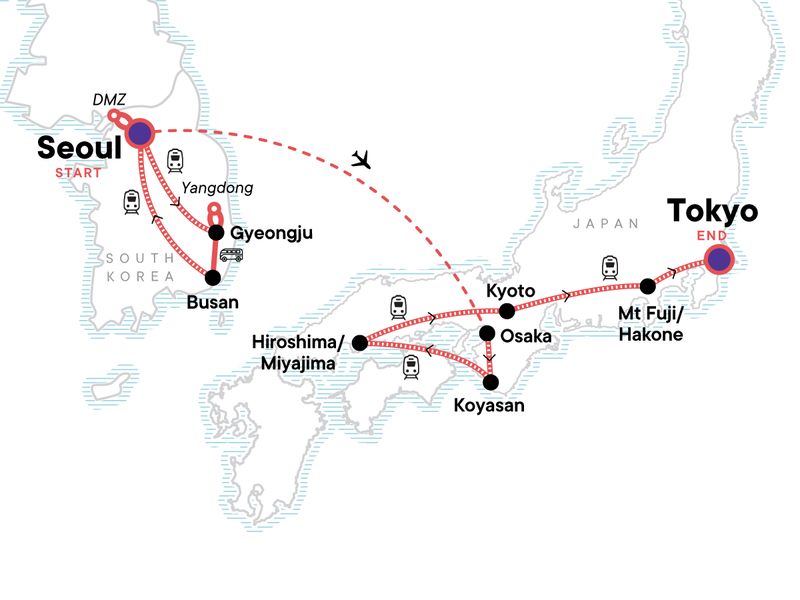
 Japan, South Korea
Korea & Japan Encompassed
Welcome to Seoul! As fellow travellers are arriving throughout the day, there are no planned activities until a group meeting at 6 pm. Check into the hotel and enjoy the city. After the welcome meeting, join your CEO for an orientation walk down Cheonggyecheon Stream to learn about Seoul while walking past small waterfalls and nearly two dozen overhead bridges. Then, enjoy the dense grid of streets found in the bustling neighbourhood of Myeongdong which is packed with people at all hours of the day looking to enjoy some of the best shopping, street food, and nightlife in all of Korea. Opt for a group dinner to end your first night!

Seoul Orientation Walk
Enjoy a brief walk with your CEO who will give you some tips on finding things like supermarkets, main squares, and ATMs. You'll be taken through Cheonggyecheon Stream which is an 8.4 kilometre (5.2 mile) waterway and public space that runs through the heart of downtown Seoul. Myeongdong is another popular spot you'll hit on your orientation walk. This exciting district features street food carts, major shopping malls, and entertainment.

Your Welcome Moment: Welcome Moment - Meet Your CEO and Group
Your opportunity to meet your CEO and fellow travellers, and learn more about your tour. Opt to join the group for a local meal afterwards. Don't forget to see the notice in the lobby (or ask reception) for the official time and place to meet up with the group.
Accommodation
Below is an example of the hotel we may use in this city. For the actual hotel your specific departure will be using, please check your voucher.

Hotel Prince
Sit back and relax on a private bus and enjoy a tour of the bustling metropolis where modern skyscrapers, high-tech subways and pop culture meet Buddhist temples and street markets. Visit Gyeongbokgung Palace, the National Folklore Museum, Bukchon Hanok Village and Insadong alley. After exploring the city, opt to see a show, explore a local museum, or hit the pavement and eat your way through street markets trying local fares such as bibimbap, soondae, and kimchi.

Gyeongbokgung Palace
Visit Gyeongbokgung Palace, the main royal palace of the Joseon Dynasty built in 1395. The palace has been destroyed many times over, but more than 50 per cent of the buildings are still standing or are restored. The complex is also home to the National Palace Museum and the National Folk Museum.

Insadong Alley
Explore the narrow and hidden alleys of one of the most memorable places in Seoul. Now filled with antique shops, galleries, tea houses and traditional restaurants, this area once housed the royal studio for painters during the Joseon Dynasty.
National Folklore Museum
Located within the grounds of the Gyeongbokgung Palace, learn about the history and traditions of the Korean people during the Joseon era.
Seoul City Tour
Enjoy a bus tour of the bustling capital of South Korea. Visit different areas of the city including Gyengbokgung Palace, National Folklore Museum, Jogyesa Temple, Bukchon Hanok Village and Insadong alley.
Free Time
Head out and explore.
Bukchon Hanok Village Exploration
Be transported back 600 years into Seoul's past while walking through Bukchon Hanok Village, which boasts the largest cluster of privately owned traditional Korean wooden homes (hanok) in Seoul. Keep an eye out for the half-dozen or so alleys that have beautifully restored architectural features like small courtyards, decorative outer walls, and dark tiled roofs.
Optional Activities - Day 2Show
Accommodation
Hotel Prince
After breakfast, board a high speed bullet train for a relaxing morning ride through the countryside to Gyeongju. Once the group arrives to this old capital city for 1,000 years, they will experience an overnight stay in a local temple. During the stay the group will learn about temple etiquette, watch a monk martial arts performance, experience the daily prayer ritual and a temple style dinner. Stay in rooms called Ondol. These rooms are very traditional, heated to be cozy and comfortable, with beds made up directly on the floor. The rooms here are multi-share, divided up by male and female rooms. Enjoy a traditional dinner and breakfast during the stay. Have the opportunity to learn about temple etiquette, experience the daily drum and bell ritual and take an easy hike up to the only stone cave temple in Korea for morning meditation.
Your Local Living Moment: Overnight Temple Stay
Stay in rooms called Ondol, which are very traditional and heated to be cozy and comfortable with beds made up directly on the floor. The rooms here are multi-share, divided up by male and female rooms. Enjoy a traditional dinner and breakfast during the stay.

Bullet Train
Get to your next destination faster than the speed of light (ok maybe not that fast) aboard a high-speed train.
Accommodation
Golgulsa Temple Stay
Enjoy a peaceful morning meditation, martial arts practice, and drum and bell ritual before exploring in Gyeongiu. On the city tour visit to the UNESCO site of Bulguksa Temple located on the slopes of Mount Toham and admire the national treasures there, such as Dabotap and Seokgatap stone pagodas, Cheongun-gyo, and two gilt-bronze statues of Buddha. Enjoy a visit to Yangdong Folk Village, a 500-year-old UNESCO site located in Gyeongju National Park, to get a feel for life during the early Joseon Dynasty. Afterwards, experience the oldest surviving astronomical observatory in Asia, Cheomseongdae Observatory, and the surrounding Royal Tombs. After a great day in Gyeongju, travel by private bus to Busan.
City Tour of Gyeongju
Visit sights around Gyeongju on an included tour. See the UNESCO site Bulguksa Temple, a head temple of the Jogye Order of Korean Buddhism and encompasses seven National treasures of South Korea.

Yangdong Folk Village
Get a fascinating look into life during the Joseon Dynasty on this visit to the Yangdong Folk Village. Founded in the early 1400s, the village boasts well-preserved buildings and has more than 160 homes displaying traditional Joseon architecture within a gorgeous natural setting.
Cheomseongdae Observatory
Nestled in the heart of Gyeongju, the capital of the former Silla Kingdom, Cheomseongdae may not appear to be a monumental landmark. But this observatory tower that dates back to the seventh century is actually the oldest existing astronomical observatory in all of East Asia. Cheomseongdae was used for observing the stars in order to forecast the weather in the ancient scientific hub of Gyeongju.
Daereungwon Tomb Complex
The Daereungwon Tomb complex in Gyeongju holds 23 tombs that are found inside of large mounds. The complex is beautiful with its rolling mounds and gardens, but the real treat can be found inside the tombs, the most famous being Cheonmachong and Hwangnamdaechong. Each tomb holds thousands of relics that gives us a window into the Silla Dynasty and its royal family. The contents of these tombs are over 1,500 years old and a great treasure to anyone who enjoys Korean history and artistic beauty.

Private Vehicle
Settle in and scan the scenery from the convenience of a private vehicle.
Optional Activities - Day 4Show
Accommodation
Swiss Rosen Hotel Gyeongju
Spend the day getting to know colourful Busan visiting the 14th century seaside temple hidden in the rocks - Haedong Yonggungsa. After exploring the temple, visit the colourful Gamcheon Culture Village, the bustling Jagalchi fish market, Gukjesijang market, and Yongdusan Park. The evening is yours to explore as you wish. Opt to take a see the Busan skyline with a nighttime yacht experience or ride the Coastal Monorail.
Busan City Tour
Get to know the city. Explore Busan, visiting the sights.
Haedong Yonggungsa Temple Visit
Originally built in 1376, this picturesque, cliffside Buddhist temple overlooks the East China Sea. Opt to grab a bizarre local snack at the traditional market. Legend foretells that should you pray here, at least one of your wishes will come true.
Gamcheon Culture Village
Explore the pastel-coloured village of Gamcheon, nestled in the side of a mountain, with uniquely painted houses, murals, cafes, and shops.
Yongdusan Park Visit
Visit Yongdusan Park, home to more than 70 different types of trees, and see the 118m (387 ft) high Busan Tower. The park's unique shape is said to look like a dragon's head.
Gukje Traditional Market
Gukjesijang or Gukje Market is nestled near Biff Square, a well-known modern movie district in Busan. The market once was a place for refugees to earn a living over the period of the Korean War. Now, it's a bustling international market where loads of food, home goods, clothes, souvenirs and more can be found.
Jagalchi Fish Market
Discover this market and major attraction at Nampo Port. Wander through the rows of stalls selling everything you can dream of from the sea. Watch as locals haggle for the best price and fishmongers hawk their wares.
Optional Activities - Day 5Show
Accommodation
Felix Hotel by STX
In the seaside city of Busan, visit Haeundae Beach and Dongbaekseom Island, before traveling back to Seoul. After arriving in Seoul by train, check out Korea's oldest traditional market - Namdaemun Market. Then make your way by cable car to N Seoul Tower to see this beautiful landmark and opt to make the trip up to the observation deck. Spend the rest of your day in Seoul opting to see Banpo Bridge, the floating islands, or hanging out in the Gangnam district.

Haeundae Beach and Dongbaek Island (APEC House) Visit
Visit Haeundae Beach, one of Korea's most beautiful beaches. Enjoy a walk along the shore, or take a swim (don't forget your suit!) And see the famed APEC House built to host the Asia-Pacific Economic Corporation (APEC) summit meeting in 2005 on Dongbaek Island.
Bullet Train
Get to your next destination faster than the speed of light (ok maybe not that fast) aboard a high-speed train.
Namdaemun Market Visit
Dating back to 1414, this is Korea's oldest traditional market and it's largest, with over 10,000 vendors spanning several city blocks. Get ready to shop!
N Seoul Tower Visit
Take the cable car to visit the most iconic landmark in Seoul! Located at the top of Mt Namsan, and standing at 480m above sea level, what used to be a broadcasting station before it was open to the public, is now a beautiful observatory. If you'd like to go up the tower to the observatory an additional fee is required.
Optional Activities - Day 6Show
Accommodation
Hotel Prince
Visit the Demilitarized Zone (DMZ), founded in 1953, separating North and South Korea. With over a million soldiers on watch each day, it is one of the last remnants of the Cold War. With a buffer zone 4km wide and spanning 250 km long there has been very little development in the area, therefore nature and wildlife have pretty much taken over. Spend about 3-4 hours visiting the Demilitarized Zone, then head to The War Memorial of Korea. Later, return back to Seoul for another night in the city. Opt to visit the Samsung Leeum Contemporary Gallery, explore the Itaewon neighbourhood, or prebook the Kimchi making and Hanbok experience.
Private Vehicle
Settle in and scan the scenery from the convenience of a private vehicle.
Korean Demilitarized Zone (DMZ) Visit
Visit the Demilitarized Zone (DMZ) the de facto border between North and South Korea, which cuts the peninsula in half. Created in 1953, it is the most heavily militarized border in the world.

The War Memorial Hall of Korea
If you love history - dive right into The War Memorial of Korea. The memorial building serves to exhibit and memorialize the military history of Korea and preserve materials related to the Korean War. Divided into indoor and outdoor exhibits containing about 9,000 artifacts, there sure is a lot to see here!
Optional Activities - Day 7Show
Accommodation
Hotel Prince
Say annyeong to South Korea and konnichiwa to Japan as we depart one incredible place and start our adventure in a new one. Upon arrival in Osaka, take some time to rest or explore on your own. There aren't any activities today until the evening where you'll join your CEO and group for a Japan Welcome Meeting.

Plane
Look! Up in the sky! It's a bird! It's a plane! It's... yup, it is a plane, actually.
Your Welcome Moment: Welcome Moment - Meet Your CEO and Group
Your opportunity to meet your CEO and fellow travellers, and learn more about your tour. Opt to join the group for a local meal afterwards. Don't forget to see the notice in the lobby (or ask reception) for the official time and place to meet up with the group.
Accommodation
City Route Hotel
Travel to the centre of Buddhism in Japan and sleep in a temple atop the 800m Mt Koya. Savour a traditional dinner of shojin ryori (Buddhist vegetarian cuisine). Journey to Mt Koya, a religious centre founded in 816 by the Buddhist monk Kobo Daishi. The train ride up the mountain is possibly one of the finest rail journeys in Japan. For the final steep ascent, switch to funicular and then hop on a bus to reach the monastery. In the evening, dine on shojin-ryori, typical vegetarian cuisine, and relax in a yukata, or kimono.
Train
Climb aboard, take a seat, and enjoy the ride.
Your Local Living Moment: Overnight in Mount Kōya Temple
During the overnight stay in the mountain temple, witness the routines of the monks and dine on typical fare. Explore the temples and moss covered Oku-no-in cemetery in the afternoon. In the evening, savour the shojin-ryori vegetarian cuisine, and relax in a yukata or kimono. Early morning at the temple offers the chance to observe the monks praying, before a vegetarian breakfast. Breathe the fresh mountain air and soak in the beautiful surroundings.
Accommodation
Sekishoin
Watch the monks pray in the morning and enjoy a traditional breakfast. Have some time to enjoy Koyasan this morning, before travelling to Hiroshima this afternoon. Early morning offers the chance to observe the monks praying. Breathe in some fresh mountain air before a vegetarian breakfast, then start the journey back down the mountain via bus, train and funicular. Later, board a train to Hiroshima, a historically significant city, marked by the explosion of the first atomic bomb in 1945.
Bullet Train
Get to your next destination faster than the speed of light (ok maybe not that fast) aboard a high-speed train.
Oku-no-in Cemetery Visit
Oku-no-in is the most sacred site in Koyasan and the location of the mausoleum for Kobo Daishi (also known as Kukai), the founder of Shingon Buddhism. The area is surrounded by a massive cemetery, the largest in Japan. With over 200,000 tombstones lining the almost 2km path to Kobo Daishi's mausoleum, there is plenty of area to explore. Be sure to see Torodo Hall (Hall of Lamps), the main place of worship, where more than 10,000 lanterns are kept burning day and night.
Accommodation
Toyoko Inn Hiroshimaeki Shinkansenguchi Ⅱ
This morning, visit the Peace Park and Memorial Museum commemorating the events of 1945. In the afternoon, take a ferry ride over to the sacred island of Miyajima to see the famous floating Torii Gate. Opt to hike around Mt Misen.
Hiroshima Park and Peace Memorial
Walk through the Peace Park in the centre of Hiroshima, a living memorial dedicated to the tens of thousands who died from the atomic bomb blast in 1945. Visit the statue of Sadako Sasaki, a young girl who died of leukemia as a result of the bomb blast, despite folding 1,000 origami paper cranes to appeal to the gods to make her well. See the frame of the Gembaku Dome, the sole building to withstand the explosion. Reflect, remember, and be reminded of the power we all hold to create peace.

Ferry
Hop a ferry to reach the island and journey back in the evening.

Miyajima Island Visit
Take a trip to Miyajima Island, famed as one of Japan's most scenic spots, with a free afternoon to explore. See the famous floating Torii Gate, set out in the bay, which glows extraordinarily at sunset. The island is dotted with shrines and temples, populated by deer, and traversed with hiking trails for those who want to get some exercise. There are also lanes full of souvenirs and tasty treats. Visit Miyajima at your own pace, and have the option to hike up to the peak of the island, Mt Misen, to see spectacular views of the surrounding islands.
Free Time
Free time on Miyajima Island to make the most of this beautiful location.
Optional Activities - Day 11Show
Accommodation
Toyoko Inn Hiroshimaeki Shinkansenguchi Ⅱ
Travel to Kyoto and start exploring. Visit the impressive Nijo Castle and gardens, a UNESCO World Heritage Site. In the evening, explore the geisha district of Gion on a CEO-led walking tour.
Bullet Train
Get to your next destination faster than the speed of light (ok maybe not that fast) aboard a high-speed train.
Local Train
Climb aboard, take a seat, and enjoy the ride.
Gion Walk
Walk through Gion, Kyoto's most famous geisha district. Visit shops, restaurants and ochaya (teahouses), where geiko (Kyoto dialect for geisha) and maiko (geiko apprentices) entertain.
Nijo Castle and Gardens Visit
Visit the Nijo Castle, the residence of the first shogun of the Edo Period built in 1603. Now a UNESCO World Heritage Site, the property is divided into three areas: the Honmaru (main circular fortification), Ninomaru (secondary circle of defense), and the gorgeous gardens that surround both.
Accommodation
Prince Smart Inn Kyoto Sanjo
Enjoy a visit to the beautiful Fushimi Inari Taisha shrine and walk under the bright torii gates. Opt to shop, stroll along the riverbank, or explore another of Kyoto's many temples with free time.
Fushimi Inari Taisha Shrine Visit
Visit the Fushimi Inari shrine, located just outside of Kyoto. Walk under the thousands of iconic torii gates (as seen in the film Memoirs of a Geisha) and enjoy the peaceful atmosphere. The shrine itself is at the base of the Inari mountain but includes many trails up to smaller shrines in the area.
Free Time
Continue exploring Japan's historic capital with some free time.
Optional Activities - Day 13Show
Accommodation
Prince Smart Inn Kyoto Sanjo
Take a boat ride on Lake Ashino-ko, and hopefully catch a glimpse of majestic Mt Fuji. Enjoy a feast on a traditional Japanese kaiseki meal then soak in the natural hot springs. Travel to Hakone, a town in the hills famous for its onsens, or natural hot springs. In the evening, enjoy savouring a complex meal of traditional Japanese foods, followed by a recommended soak in the onsen.
Bullet Train
Get to your next destination faster than the speed of light (ok maybe not that fast) aboard a high-speed train.
Local Bus
Climb aboard, grab a seat, and enjoy the ride.
Lake Ashino-ko Boat Ride
Hop aboard a passenger boat to cruise the waters of Lake Ashinoko. If you are lucky, on a clear day you can capture a view of Mt Fuji. The lake was formed from the caldera of Mt Hakone following its eruption 3000 years ago. Sit back, relax and enjoy.
Traditional Kaiseki Meal
Savour a complex meal of traditional Japanese foods, then finish the day with a soak in the onsen.
Accommodation
Hotel Kagetsuen
Head to Tokyo with time to do some last-minute shopping. Arrive before noon to Tokyo, with time to explore this energetic metropolis. Opt to visit Ueno park and the museums, Akihabara for cutting edge electronics, Harajuku for funky fashions, Ginza for the highest of the high end, walk the grounds of the Imperial Palace East Garden, or just stroll the streets, looking for the traditional life that still lies just under the modern surface.
Free Time
With so much to do, start exploring now.
Local Train
Climb aboard, take your seat, and get around like the locals do.
Optional Activities - Day 15Show
Accommodation
The B Akasaka
Depart at any time.