
- Matthew B. Shaw
- •
- surfer.com
- •
- November 12, 2025
Editor's Note:Of all the strange guests at the unofficial SURFER House on the North Shore, former staff writer Matthew Shaw takes the honors of "best guest". Rather than snoring and boring, he's calm, discreet, and sure knows how to talk a good story. When it comes to music & surfing, he may very well be America's foremost scholar. His book, The Ocean Will Have Us All: Surf Music in America, is due out in September of 2026 on Chicago Review Press.
Nirvana’s Nevermind dropped in the fall of 1991. It made the Pacific Northwest trio a global phenomenon. And opened the floodgates for heavy, punk-inflected music from an obscure corner of America. It was a seminal moment in music history: The Year Punk Broke, so named for the unsung documentary that follows Sonic Youth and several ’80s-underground A-listers – Dinosaur Jr., Babes in Toyland, Mudhoney, Nirvana – as the bands toured Europe in the summer of ‘91.
Filming for the doc wrapped with a September 1 show in the Netherlands. Nevermind landed on September 28. By January of ‘92, the album hit #1 on the Billboard charts, knocking Michael Jackson’s Dangerous from the top spot. Nevermind took punk to the top of the charts. But long before Nirvana kicked the door off the hinges of the genre’s commercial potential, punk had been resuscitated and cultivated in and by the surf and skate communities of Southern California.
Ryan Watanabe
A decade prior to Nevermind, in the pages of this very publication, the Australian surf writer John Witzig called the shot. Visiting California for the first time in over a decade, Witzig was trying to get a handle on why the State, the crucible of surf culture in the ‘50s and ‘60s was no longer producing world-class surfing talent. He found a young Tom Curren. He hiked into The Ranch with Sam and Matt George. He also found punk rock.
Witzig seemed to like The Dead Kennedys. He found The Surf Punks’ ode to localism, “My Beach,” to be “terrific stuff.” Comparing punk to the music that powered the surf boom of the ‘60s (Dick Dale, The Chantays, The Ventures, The Surfaris, The Beach Boys), Witzig wrote: “Perhaps the Golden Age of California is coming back?” Prescient, no doubt. Just maybe a decade too early.
Ryan Michael Mendez
Commercially speaking, punk had flamed out in the late-’70s. The Stooges imploded. The New York Dolls’ schtick failed to translate beyond the five boroughs. The Ramones – the most enduring act to emerge from punk’s initial wallop – could never quite get over the hump. Even The Sex Pistols, proof of the genre’s global reverberation, could only muster a single U.S. tour.
But against all odds, punk found its way into SoCal’s coastal hamlets and suburban enclaves. Many of the region’s earliest converts had made the pilgrimage to see The Pistols play San Francisco’s Winterland Ballroom in ‘78. They’d followed the Ramones from L.A. to San Diego to Redondo Beach the year before. They listened to Rodney on the ROQ spin the latest punk releases on L.A.'s K-ROQ FM. Soon the region was teeming with punks. By the time Witzig arrived, The Germs and X, T.S.O.L. and Agent Orange, The Descendents, The Vandals, Social Distortion, Black Flag were spreading the punk gospel from Hollywood to Fullerton, Manhattan Beach to Encinitas.
As punk was, first and foremost, a reaction to mainstream culture, surfing’s relationship to the genre was complex from the start. Surfers were viewed by many of the earliest punks as either groovy-’60s holdovers or, worse, jocks. The kinds of folks who listened to the type of fussy, technically-impressive, commercial rock that punk sought to destroy.
But surfing was part of the music’s genetic code. The Kingsmen’s “Louie Louie” and The Trashmen’s “Surfin’ Bird” – two of punk’s most important sonic predecessors – drew inspiration from surf music (as did much of the garage rock found on Lenny Kaye’s Nuggets compilation, a founding document of punk). The Ramones drew liberally from the Beach Boys’ melodic template. Agent Orange’s debut, Living in Darkness, features a cover of Dick Dale’s surf-rock opus “Miserlou.” And surfers, it should be noted, filled the ranks of many of SoCal’s earliest punk outfits.
In the ‘80s, SoCal punk bands – especially Black Flag – did much to disseminate the music and its rigidly-DIY ethic. Through word of mouth, the distribution of independent zines, and incessant touring through all pockets of America – which found them playing $5 matinee shows and sleeping on dirty venue floors – punks from SoCal’s surf and skate communities helped build the indie culture of the ‘80s; the foundation from which Nirvana was able to build.
By the mid-’80s, punk was animating new movements in surf culture; most notably the progressive surfing and brash visual aesthetic of the Echo Beach contingent. But it was Taylor Steele’s Momentum in 1992 that cemented the connection between surfing and punk rock.
Steele’s handpicked subjects hailed from surfing’s new school: Slater, Machado, Weatherly, Dorian, Knox, Robb, Frankenreiter, Malloy, Malloy, Malloy, all household names today. They adopted an aggressive, skateboard-influenced approach, prioritizing tricks – flying above, sliding across, or aggressively bashing the top of the wave’s face – over grace and composure. Instead of near-perfect waves breaking in remote, tropical locales, Momentum highlighted marginal conditions – crappy beachbreaks, onshore winds. Its low-res handi-cam footage was choppily edited and frantically paced, and set to a soundtrack of melodic punk by then-underground SoCal bands. A MacGillavry-Freeman production this was not. And there was nary a “High In Middle” to be found on its score.
Momentum turned surfing on its ear. It ushered in a new nadir of surfing’s mainstream influence; one in which a surf movie score was capable of minting new music stars. Indeed, two years after Steele released Momentum, L.A.’s Bad Religion, who’d contributed six songs to the movie, struck gold with the release of their major label debut, Stranger than Fiction, on Atlantic Records. That same year, Bad Religion’s own independent label, Epitaph, released Smash, the second album by Orange County punks The Offspring, which would go on to become one of the best-selling punk albums of the decade. Another Epitaph band, Pennywise – credited as “penny wise” in Momentum – also broke through that year.
“Taylor [Steele]’s movie was the biggest thing that ever happened to our band,” Pennywise guitarist Fletcher Dragge says in the 2018 documentary, Momentum Generation. “It changed our lives forever,” added the band’s singer, Jim Lindberg. Scott Russo of Unwritten Law put it more plainly: “There would no Unwritten Law without the Momentum videos.”
Then came the Warped Tour. While Momentum and Steele’s many follow-up films, as well as movies by …Lost, helped break dozens more bands in the years that followed, it was the Warped Tour that brought this idiosyncratic music and culture – long percolating in the surf communities of SoCal – to the masses.
Founded by Orange County punk obsessive and budding impresario Kevin Lyman, the Warped Tour kicked off in Salt Lake City in 1995. Perhaps a bit more indie than punk, the first Warped Tour did much to break two then-unknown SoCal bands: One, a ska quartet from Anaheim fronted by a charismatic singer named Gwen Stefani; the other, a trio of crate-digging madmen who’d cut their teeth entertaining fellow surfers at house parties in-and-around the L.B.C. While Warped Tour’s first year was a financial disaster, the eventual success of both No Doubt and Sublime established the festival as a kind of weathervane for ‘90s music.
Vans signed up to underwrite the festival in year two. Pennywise joined, as did another Momentum-film fave, Blink-182. By year three, a resurgent (rockabilly-influenced) Social Distortion was co-headlining with The Ramones, as skateboarders, BMX’ers, and inline skaters launched high above the coping of the festival’s famed “mega ramp.” In the last five years of the decade, Warped Tour lineups often seemed as though they were cribbed from the credits of surf movies, or from the leather CD cases of surfers. In addition to Bad Religion, The Offspring, Unwritten Law, NOFX, The Vandals, (Donavon Frankenreiter’s band) Sunchild, and Suicidal Tendencies, all popular bands among surfers of a certain age, all performed at Warped Tour. As did Strung Out, Sprung Monkey, Rocket From the Crypt, Rancid and Pepper, MxPx, Less Than Jake, Goldfinger, Flogging Molly, Descendents, Agent Orange, Adolescents, and 311.
A potent example of the rising-tide-lifts-all-boats relationship between punk and surfing on the Warped Tour: In ‘99, former Billabong exec Bob Hurley essentially used the Warped Tour as a launching pad for his eponymous surfwear brand. Part of the deal, according to the book Tearing Down the Orange Curtain, committed Blink-182 to wearing Hurley gear on stage during the festival in exchange for free seats on the festival’s tour bus. Of course, a few years later, Blink would have their own bus(ses) and Hurley was so hot that it was acquired by Nike.
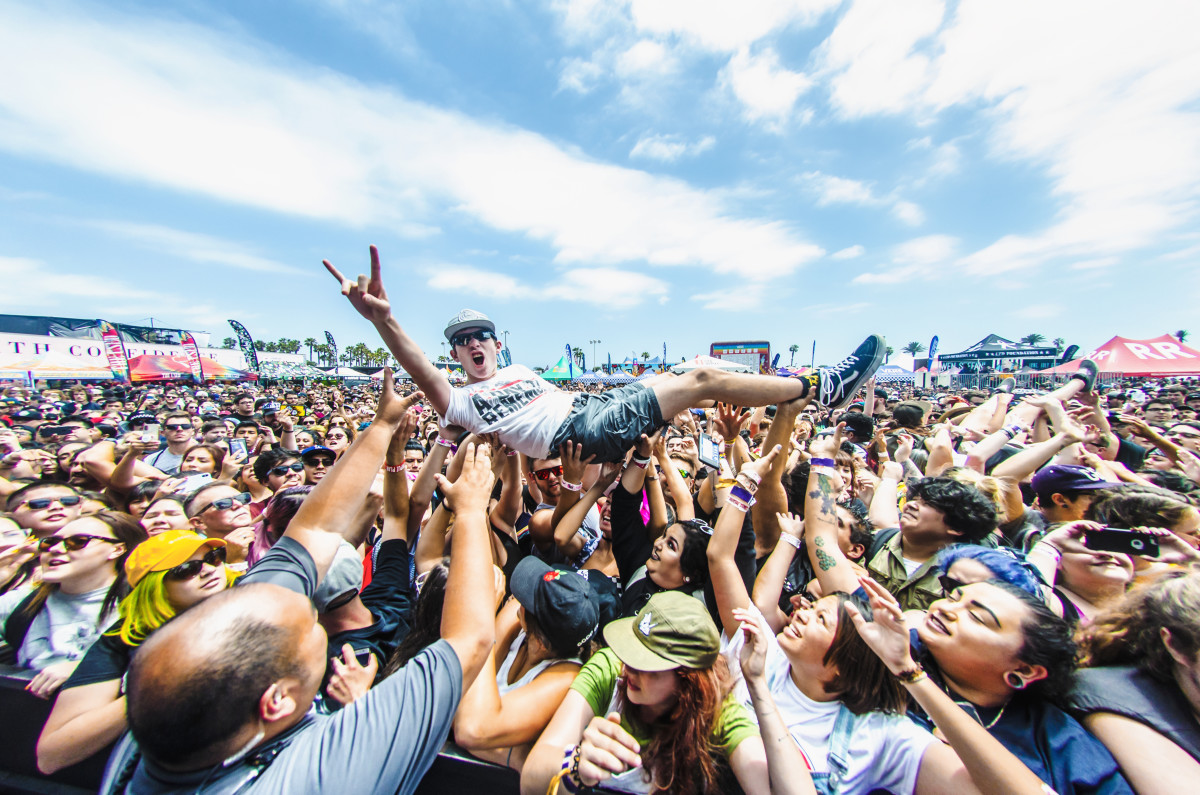
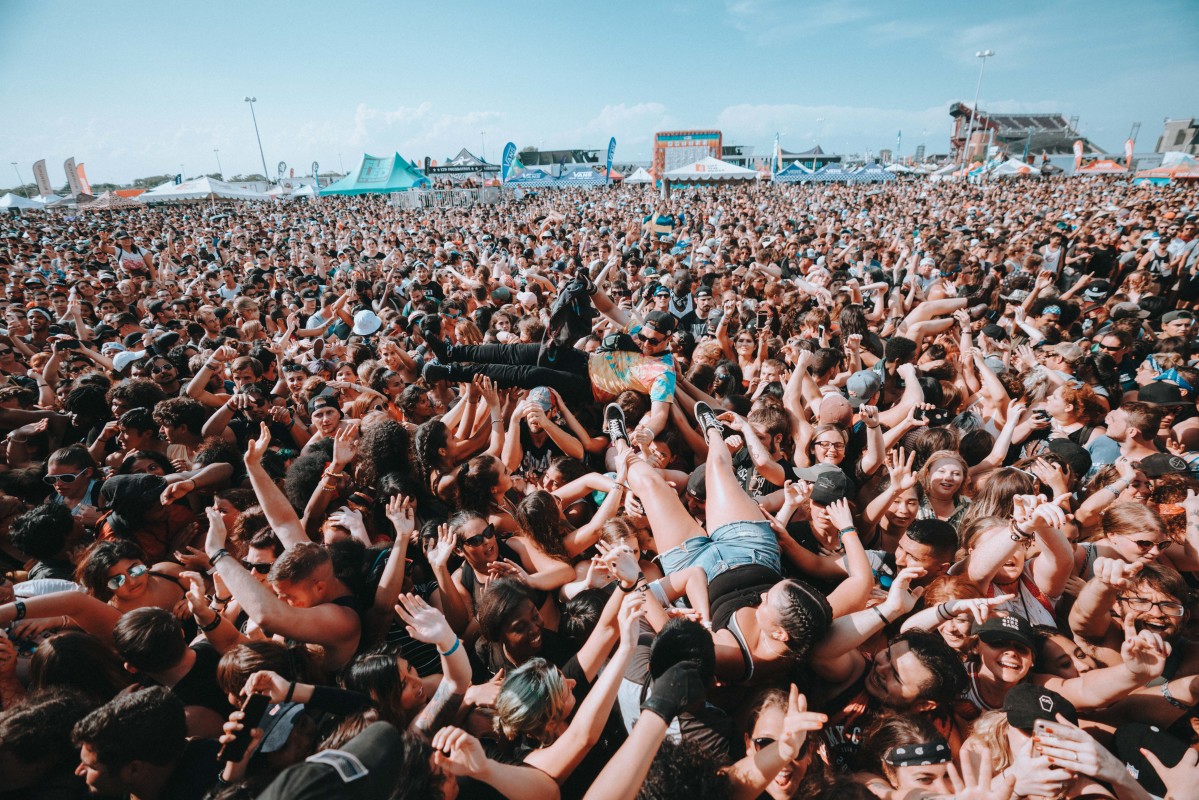
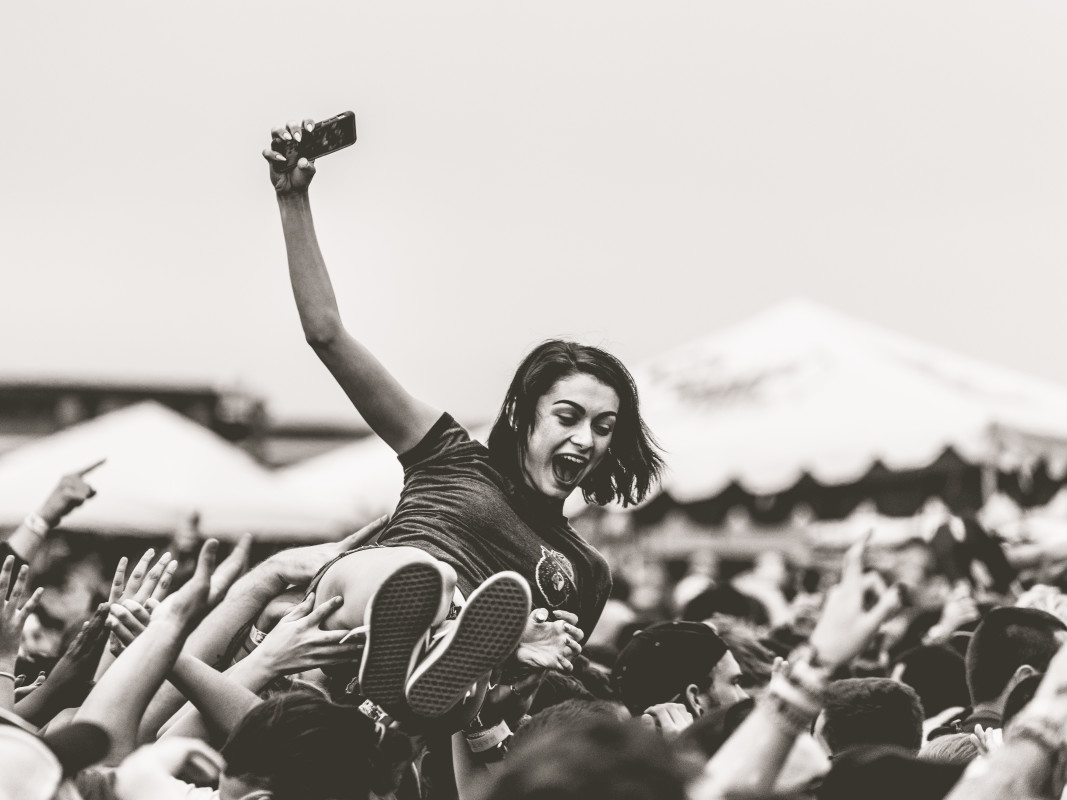
Certainly, in the era of X-Games, MTV Sports, and Mountain Dew, there were a host of extenuating cultural and commercial forces that helped amplify The Warped Tour. It was a phenomenon, no doubt. And it had its detractors – check out Sam George’s 1998 SURFER essay “Is Surfing Hip?” for a thoughtful example of how surfing’s subsummation into the “action sports” market was perceived at the time. Music critics didn’t love it, either, often dismissing the festival as a commercial perversion of punk rock’s original ethos. But music critics, being generally urbane voices, tend to be turned off by anything once it reaches beyond the cultural capitals of L.A. or N.Y.C. Over their upturned noses, they couldn’t see that the Warped Tour was fulfilling the promise of the hardcore and DIY scenes of the ‘80s. By stopping in places like El Paso, Texas and Peoria, Arizona; Antioch, Kentucky and Virginia Beach; Fresno and Ventura, as much as the Warped Tour made punk mainstream, the festival brought it to its intended audiences: marginalized kids living in neglected pockets of America.
And 30 years since a ragtag group of punks crashed on the floor Kevin Lyman’s San Diego home in anticipation of the first Warped Tour stop, the festival has once more pulled the ramps out of the shed, and gotten some of the bands back together, for a trio of reunion shows in the Midwest, California, and the Southeast. All three festival stops sold out shortly after they were announced.
This weekend, on November 15 and 16, The Warped Tour celebrates its 30-year anniversary with the third and final stop in Orlando, Florida. Pennywise will be there. As will Less Than Jake. In addition to more than 100 bands, there will be ramps, art installations, and even a Warped Tour history museum. And while if you’re curiosity about new music didn’t extend beyond the soundtracks of ‘90s surf movies, you’re unlikely to recognize the majority of this year’s lineup, the festival’s confluence of abrasive rock and extreme sports remains in-tact; certain to stir up feelings of nostalgia for surfers of a certain age bracket.
And the Warped Tour isn’t the only event taking place in Central Florida this weekend with ties to surfing’s enduring cultural impact. Beginning Thursday, November 13, The Florida Surf Film Festival presents its fourth quarter installment, screening a dozen films over two nights. Held at the News-Journal Center in Daytona Beach, over the course of a dozen years FSFF has grown into one of the globe’s premier surf film festivals while outgrowing its original digs at the Atlantic Center of the Arts in New Smyrna. In addition to bestowing its annual awards – best surf film, best documentary, best cinematography, best soundtrack – this weekend’s event includes a live recording of David Lee Scales and Chas Smith’s “The Grit” podcast (interviews with Raglan Surf Report’s Luke Cederman and John Philbin from North Shore and Point Break) on Thursday. Friday’s programming includes a screening of Kathryn Bigelow’s cult-classic surf-heist, Point Break, and a Q&A with Philbin. Saturday’s programming includes a Raglan Surf Report compilation and a screening of Peter King’s new doc, PIPELINE. Tickets here.
While this weekend’s Warped Tour has been sold out for months, there are tickets available via third-party resellers like Stubhub. As for FSFF, there are limited tickets available for Thursday’s pre-fest event but plenty of single and two-day passes for the festival proper. Depending on your interest, your commitment to surf culture, your proximity to Central Florida, it’s conceivable you could do both. Arguably, that’d be pretty punk.
Matthew Shaw's a former staff writer for Surfer. His book, The Ocean Will Have Us All: Surf Music in America, is due out in September of 2026 on Chicago Review Press.
Related: Grateful Dead Get Into the Surf Music Groove in Rare 1975 Studio Outtake (Listen)